
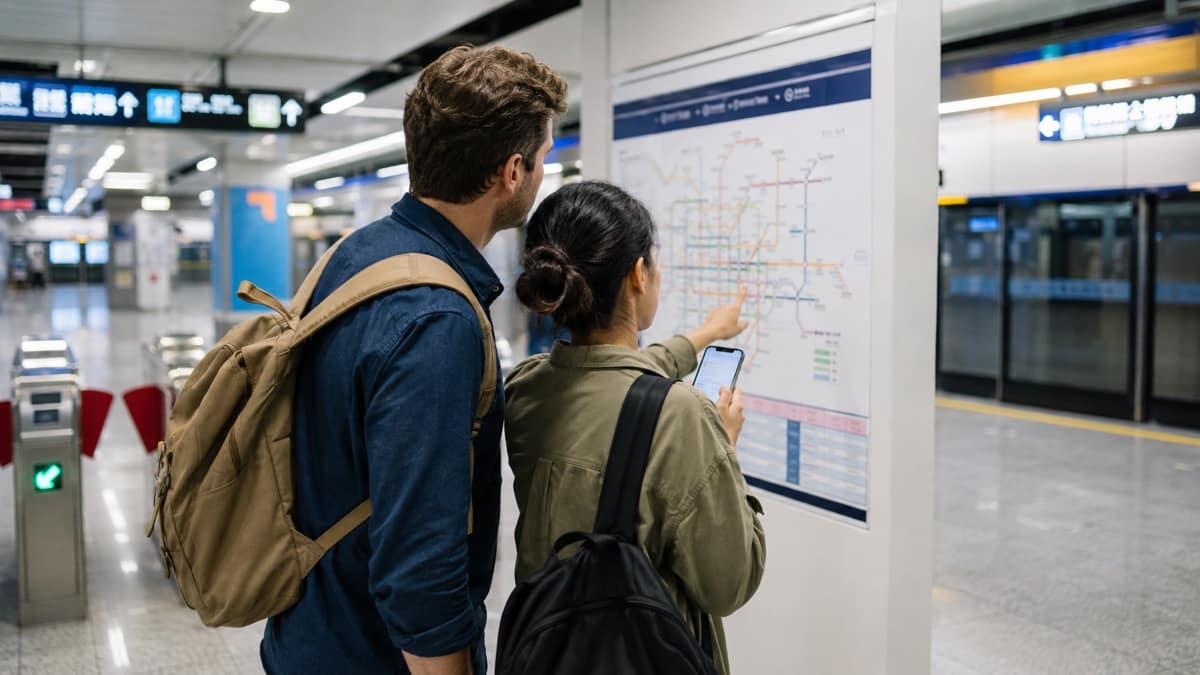

China’s urban metro systems can be one of the simplest ways to cross a large city, but a smooth ride depends on local details: which payment methods the gates accept, whether a ticket works for a transfer, which station exit is closest to your destination and when the last train leaves.
This guide gives first-time international visitors a repeatable workflow that works as a planning framework across Chinese cities. It also uses Beijing and Shanghai as clearly labeled examples. Do not assume that a bank card, app, fare or pass described for one city will work in another; confirm the current rule on the local metro operator’s official channel or at the station.
Information check: The government and public-service sources linked below were reviewed on September 3, 2026. Operating hours, fares, accepted cards, app screens and station arrangements can change. Check the specific city and travel date before relying on them.
Before your first metro ride
Save the destination in Chinese
Store the Chinese name and address of your hotel, attraction or meeting place. A translated business name may not match the name shown on station maps. Save the nearest station and exit only after checking the destination’s official directions or a current map.
Keep the address available offline. The China hotel booking and check-in guide explains how to prepare a hotel’s Chinese name, address and phone number before arrival.
Set up data, but keep an offline fallback
Mobile data helps with route planning, translation and QR-based transport services. Complete setup before you reach the station; underground reception can be uneven, and an app may require registration or identity verification before it displays a transport code. Use the China SIM card and mobile internet guide to prepare a working connection.
Take a screenshot of the route, destination name, transfer stations and final exit. A screenshot is not a ticket, but it remains useful if the network or app becomes unavailable.
Carry two workable payment methods
The State Council’s national guide says foreign travelers can generally buy single-journey tickets at station ticket offices or machines, and describes cash, bank cards and mobile payments as possible methods. It also says some mobile-payment and metro-operator apps support QR-code gate entry. The same guide tells visitors to refer to station signs or staff for the payment methods that apply locally.
That final qualification matters. Prepare the method you expect to use plus a backup, such as renminbi cash or another supported option. The China mobile payment guide covers international-card setup and practical payment backups.
Choose a payment method with this decision tree
Option 1: Buy a single-journey ticket
For a first ride, a single-journey ticket can be the lowest-friction choice. Find the destination station on the machine or ask at the service counter. Before paying, check that you selected the correct station, because cities can have similarly named stations and multiple railway or airport terminals.
Keep the ticket until you have left the destination station. Depending on the system, the exit gate may retain a physical ticket or require another scan. If the gate rejects it, do not force the barrier; use the nearby service point.
Option 2: Use a city transport card
A stored-value card can be useful for repeated rides, but purchase, deposit, top-up and refund arrangements differ. Ask whether the card is valid only in that city, whether it works on buses or airport lines, and where any remaining balance can be handled. Do not buy a multi-day or third-party card based only on a vague online description.
Option 3: Use a transport QR code
Some cities offer a metro code through Alipay, WeChat Pay or a local transport app. Select the correct city and service before approaching the gate. A merchant-payment QR code is not automatically the same as a metro boarding code.
Open the code before joining the queue, raise screen brightness if needed and keep the phone charged. At the exit, use the same account and code used for entry unless the local service explicitly instructs otherwise. If registration, identity verification or card linking fails, switch to a ticket or staffed counter instead of creating repeated accounts at the gate.
Option 4: Tap an eligible contactless bank card
Direct card entry is city-specific. Confirm the accepted card networks, card type, gate markings and any contactless settings before treating it as your primary method. Use the same physical card or device to enter and exit; switching between a card and the phone wallet that contains it may be recorded as two different payment credentials.
A seven-step metro workflow
Step 1: Check the first and last train
Operating hours vary by line, station, direction and date. “The metro closes at a certain time” is rarely precise enough for a late journey. Check the last departure from your boarding station in the direction you need, plus the final connection at any transfer station. Leave a realistic buffer for walking, security and a wrong exit.
Step 2: Plan by station and exit, not only by attraction
A large station can have many exits on different sides of a road, inside a shopping complex or several minutes apart. Plan the line, direction, transfer and exit number. Recheck the exit after reaching the destination because construction or temporary closures can change access.
Step 3: Pass the security check
Many metro stations screen bags before the paid area. Follow staff directions and keep small items together so nothing is left at the belt. Rules for liquids, prohibited items and oversized luggage can differ; check the local operator before carrying anything unusual.
Step 4: Enter with one fare medium
Use one ticket, card or QR service for the complete ride. Watch for the gate’s acceptance signal before walking through. Keep children and luggage clear of the barrier, and use an accessible or wide gate when staff direct you to one.
Step 5: Confirm the direction on the platform
Match the line number or color, destination terminus and next station. The name of your destination may not appear on the largest sign if it is an intermediate stop. Compare the next one or two stations with your saved route before boarding.
Step 6: Follow transfer signs without exiting
At a transfer station, follow signs for the connecting line. A valid in-station transfer usually does not require passing an exit gate. If a route sends you outside the paid area, ask at the service desk whether a new fare or ticket is required rather than assuming every out-of-station transfer is included.
Step 7: Exit and orient before walking away
After the exit gate, find the numbered or lettered exit sign and match it to the street direction. If the planned exit is closed, use the station map to choose the nearest open alternative. Open your map only after moving away from the gate flow.
What to do when something goes wrong
| Problem | Safe next step |
|---|---|
| Ticket or card is rejected at entry | Move aside and ask at the service point; do not repeatedly tap different media on the same trip. |
| Gate rejects the exit | Show the ticket or payment method used for entry and follow staff instructions for any fare adjustment. |
| Phone battery is low | Switch to a ticket or other accepted method before entering; do not begin a QR-code ride without a realistic way to exit. |
| You boarded in the wrong direction | Leave at the next station and follow signs to the opposite platform without exiting the paid area when the station layout allows. |
| Last connection has finished | Move to a staffed, well-lit area and use an official taxi, verified ride-hailing option or prearranged transfer. |
| An item was left behind | Note the line, direction, train time, carriage position and station, then contact station staff or the operator’s official lost-property channel. |
For an airport journey, leave extra time and confirm whether the metro, airport express, maglev or suburban railway uses a separate fare. The China airport arrival guide helps compare public transport, taxis and prearranged pickup. For intercity travel, do not confuse a metro station with the correct railway terminal; use the China high-speed rail guide to match the station printed on the ticket.
Two current city examples
Beijing: five card networks at metro gates
According to the Beijing Municipal Government’s March 26, 2026 notice, Beijing Subway supports contactless gate payment, ticket purchases and top-ups with China UnionPay, Mastercard, Visa, JCB and American Express cards. The notice says passengers can tap an eligible card at designated gate sensor areas without first buying a ticket or downloading an app.
This is a Beijing example, not a national rule. Check that your card supports the required contactless function and keep a backup. Use the Beijing destination guide to group sights by area before choosing metro journeys.
Shanghai: several ticket and payment paths
International Services Shanghai’s guide, updated June 29, 2026, lists single-journey tickets, the Shanghai Public Transportation Card, Metro Daduhui, the Suishenxing app and day passes. It also describes eligible contactless cards for direct gate entry and card terminals at station service centers. Some airport, maglev and suburban services use separate arrangements, so verify the exact line rather than assuming a standard metro ticket covers it.
The same source says single-journey tickets are valid on the day of purchase and cannot be used for out-of-station transfers. That rule belongs to Shanghai’s described ticket product. Use the Shanghai destination guide to connect the transport workflow with a practical day plan.
Plan for luggage, children and accessibility needs
Large suitcases slow security, gates and transfers. Avoid the busiest commuting periods when practical, keep wheels and straps controlled, and identify lifts before choosing a station. A station shown as accessible may still have a long route between the platform, lift and street exit.
Child fares, height rules and family-gate procedures vary by city. Ask staff before entering rather than sending a child through on an adult’s payment credential. Travelers who need step-free access should confirm the entire route—including the destination exit—with the local operator or station staff. Do not assume every entrance has a lift.
Build metro rides into a realistic China itinerary
Metro travel works best when each day is clustered around a few neighboring areas. The Xi’an, Chengdu and Hangzhou destination guides can help you group activities before checking that city’s current metro map. A route that looks short by straight-line distance may still require a long transfer or walk.
For a tailored trip, CHINA FACE can organize transport, hotels and activities around your arrival times and priorities. Use the trip-planning enquiry form and share only the information needed for planning.
A 60-second metro checklist
- Save the destination name and address in Chinese.
- Confirm the city, station, line, direction, transfer and final exit.
- Check the last train for the exact route and date.
- Prepare one local fare method and one backup.
- Use the same ticket, card or device at entry and exit.
- Keep the route available offline and the phone charged.
- Allow extra time for security, luggage and large transfers.
- Ask station staff when a gate, fare or route is unclear.
Frequently asked questions
Can foreign visitors use metros in China without a local bank account?
Often, yes. The national government guide describes single-journey tickets, cash, bank-card and mobile-payment paths, but the options available at a particular station depend on the city. Check local signs or ask at the service counter.
Can I tap an overseas bank card at every metro gate in China?
No national assumption is safe. Beijing and Shanghai currently describe direct contactless card entry for eligible cards, but networks, card requirements and coverage differ. Verify the local operator’s current list.
Do I need my passport to ride the metro?
A basic single-journey ticket may not require it, while some card purchases, app registrations or identity checks may. Carry travel documents according to applicable requirements, but avoid handing a passport to anyone except authorized staff when genuinely necessary.
Are metro maps and signs available in English?
Major systems commonly display line numbers, colors and romanized station names, but the amount of English support varies. Keep the Chinese destination name and use line direction plus next-station checks rather than relying on one translation.
Is the metro always the best airport transfer?
Not necessarily. Arrival time, luggage, hotel distance, final walking route and the last train can make an official taxi or prearranged transfer more suitable. Compare the complete door-to-door journey.