
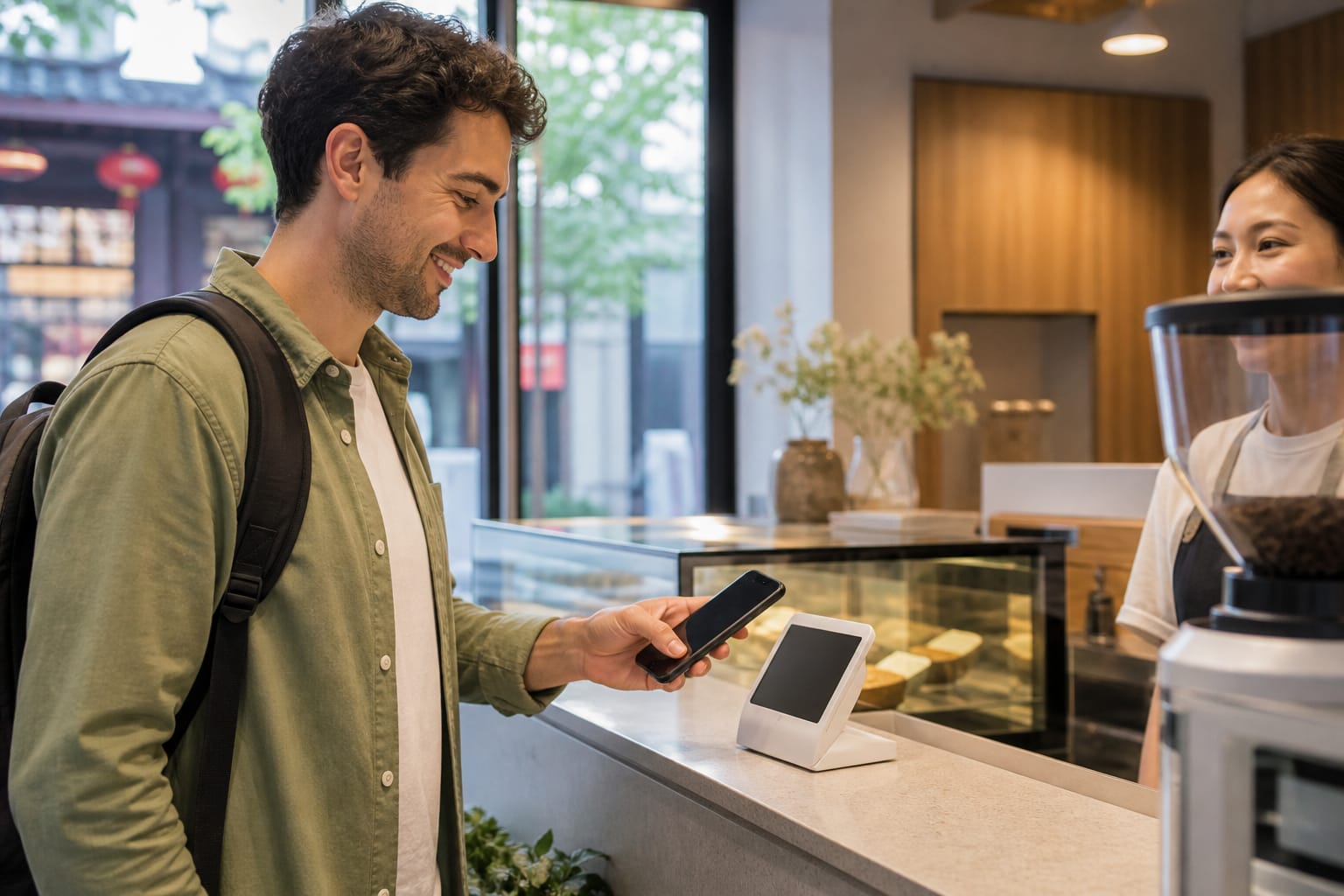

Paying in China is easier when you prepare a layered system instead of depending on one app, one card or one phone. Mobile payment is central to everyday transactions, but overseas bank cards and RMB cash remain useful parts of a visitor’s backup plan.
This guide explains how international visitors can prepare before departure, make common QR-code payments, use cards and cash, and recover when a transaction fails. It does not recommend a financial product or guarantee that a particular foreign card will work.
Information check: Official payment sources were reviewed on August 17, 2026. App interfaces, supported cards, identity checks, transaction limits, fees and exchange-rate treatment can change. Confirm current terms in the official app, with your card issuer and in the 2026 payment guide published by a Chinese embassy before relying on any method.
What payment methods can overseas visitors use in China?
Chinese government guidance describes three main options for overseas visitors: mobile payment, bank cards and RMB cash. That is also the most practical way to plan your trip. Use a mobile wallet for everyday convenience, keep a physical card as an independent second channel, and carry a modest amount of cash for situations where the other two are unavailable.
The official payment service guide for overseas visitors says foreign users can link supported international cards to major mobile-payment platforms. It also explains that bank cards may be accepted where the relevant payment-organization logo is displayed and that visitors can obtain RMB through qualified exchange outlets or compatible ATMs.
Availability is not identical at every merchant. A hotel, major attraction and neighborhood food stall may have different equipment and payment habits. Build redundancy rather than treating one successful transaction as proof that the same method will work everywhere.
Step 1: Prepare your bank cards before departure
Contact your bank or check its official app before the trip. Confirm that overseas transactions are enabled, that your mobile number can receive any required security messages, and that you understand how the issuer handles foreign-currency conversion and transaction alerts. These are issuer-specific questions; do not rely on a generic travel article for exact fees or limits.
Where practical, carry cards from two different issuers or networks. Keep them separately so a lost wallet or a single fraud block does not remove every payment option. Save the bank’s official international support number somewhere accessible without the card itself.
Step 2: Install payment apps only from official stores
Install the mobile-payment apps you intend to use from the official Apple App Store, Google Play listing available to you, or the provider’s verified official channel. Avoid download links sent in messages or displayed on unofficial help pages.
Complete the setup while you still have reliable access to your home mobile number and bank. Use your real identity details and follow the app’s current verification prompts. If a passport is requested, enter the name and document information accurately rather than shortening it to fit a preferred format.
Link an eligible overseas card through the official interface. Card support can depend on issuer, network, region and provider rules. A card appearing successfully in the wallet is encouraging, but the first real purchase can still trigger an issuer or platform check.
Step 3: Protect access to the phone and accounts
Turn on a strong device passcode and biometric protection where available. Enable transaction notifications in both the wallet and banking app. Do not share one-time codes, passwords or remote-screen access with someone who contacts you unexpectedly—even if they claim a payment has failed.
Keep the following recovery information outside the payment phone:
- your card issuer’s official support number;
- a second payment card stored separately;
- the official account-recovery path for the wallet;
- a small amount of RMB cash;
- your accommodation name and address in Chinese.
Your phone also supports transport, translation and booking confirmations. The site’s China travel technology guide explains how to prepare connectivity, charging and app backups without making the trip dependent on one device.
Step 4: Understand the two common QR payment flows
At a merchant, one of two basic flows is common:
- You scan the merchant’s code: open the official wallet, use its scan function, confirm the merchant and enter or approve the amount shown by the app.
- The merchant scans your payment code: open the payment-code function and present it only when you are ready to pay.
Before confirming, check the merchant name and amount displayed in the app. Do not assume that a printed code near a counter belongs to the business; ask staff if its placement or identity looks unclear. Keep your payment code private when you are not making a purchase.
App labels and screens change, so this article deliberately avoids a button-by-button walkthrough that could become inaccurate. Follow the provider’s current official instructions and the live prompts on your account.
Step 5: Test a small everyday purchase after arrival
Make a normal, low-value purchase in a calm setting after you arrive—ideally near your hotel or accommodation. Check that the wallet opens on the local network, the linked card authorizes, the displayed amount is correct and the transaction notification arrives.
If the test fails, solve the problem before a time-sensitive train, taxi or attraction booking. A hotel reception desk may help explain a merchant’s payment process, but only your bank or wallet provider can resolve account verification, issuer declines or blocked transactions.
How to use an overseas bank card directly
Look for the card-network logos displayed at the counter or terminal and ask whether an overseas card is accepted before the purchase is completed. Direct card acceptance is more likely in some larger hotels, major attractions and established retailers than at small mobile-first merchants, but acceptance is never guaranteed by business size alone.
Keep the physical card in sight when possible, review the amount before authorizing and retain the receipt when one is provided. If the terminal or merchant offers a currency choice, read the conversion information carefully and use your issuer’s current guidance to understand the cost. This article does not prescribe a currency option because fees and exchange rates are account-specific.
How to keep RMB cash as a real backup
Cash is still an official payment option for overseas visitors. Chinese government guidance says visitors can exchange currency at qualified outlets and withdraw RMB from ATMs displaying a compatible card-network logo.
Use bank branches, qualified exchange providers or recognized self-service facilities rather than informal exchangers. At an ATM, inspect the machine, protect the PIN and keep the receipt if issued. Your bank may apply its own withdrawal, conversion or operator fees, so verify those terms before travel.
Carry a practical mix of smaller notes rather than relying only on a large denomination. Cash is particularly useful if a phone battery dies, mobile data is unavailable, an issuer blocks a payment or a small merchant cannot process the visitor’s preferred electronic method.
What to do when a payment fails
The mobile wallet does not open
Check the network connection, app update status and phone time settings. Switch to a card or cash rather than repeatedly attempting the same payment in a queue. Resolve account access later through the provider’s official support path.
The wallet opens but the linked card is declined
Confirm the amount, check for a bank alert and try the second prepared method. The merchant usually cannot override an issuer or wallet risk decision. Contact the bank or provider using an official channel if the account shows a restriction.
The merchant’s QR code does not work
Ask whether the merchant can scan your payment code instead, or use another method. Do not scan replacement codes supplied by unrelated bystanders.
The physical card is not accepted
Look for supported network logos and try a different prepared card only if appropriate. If the merchant does not support overseas cards, use the mobile wallet or cash backup.
The phone is lost or stolen
Use another trusted device to contact the mobile carrier, wallet provider and card issuer through their official channels. Lock or suspend access as appropriate. This is why account recovery details and the second card should not live only on the missing phone.
Payment planning for transport and independent travel
Do not wait until a departure gate or late-night transfer to discover that a payment method is unavailable. Save transport bookings offline, keep enough power for the phone and maintain a separate backup method. If you are traveling alone, the solo travel guide to China provides a broader arrival and safety routine.
For multi-city journeys, combine payment preparation with the China high-speed rail guide and the complete China trip planning checklist. Business travelers can also use the China business trip planning guide to coordinate payment backups with meetings, local transport and connectivity.
China payment checklist for international visitors
- Overseas transactions enabled with the card issuer.
- Two independent cards prepared where practical.
- Official payment apps installed from verified sources.
- Identity and eligible-card setup attempted before departure.
- Phone passcode, biometrics and payment notifications enabled.
- International support numbers saved separately.
- Mobile connectivity and charging backup prepared.
- A modest RMB cash reserve obtained through a recognized channel.
- A small test purchase completed after arrival.
- Merchant name and amount checked before every confirmation.
Frequently asked questions
Do I need a Chinese bank account to use mobile payments?
Not necessarily. Chinese government guidance states that foreign users can link supported international cards to major mobile-payment platforms. Whether a specific card works depends on the current provider and issuer rules.
Should I rely only on a mobile wallet?
No. Mobile payment may be the most convenient everyday method, but a second card and cash reserve protect you from phone, network, account and merchant-specific failures.
Can I pay everywhere with an overseas card?
No universal acceptance should be assumed. Look for the relevant network logo and ask the merchant. Keep mobile payment and cash alternatives available.
Is cash still useful in China?
Yes. Official guidance includes RMB cash as a payment option and describes recognized exchange outlets and compatible ATMs. Cash remains a useful independent backup even if most daily transactions use a phone.
Are app fees and limits fixed?
No. Fees, identity requirements, card eligibility and transaction limits can vary and change. Review the live terms shown by the wallet, card issuer and merchant before confirming a payment.
Build payments into the whole travel plan
A reliable payment setup is not about finding one perfect app. It is about preparing several legitimate options, testing them early and knowing which official provider to contact when something fails. If you would like help shaping a private itinerary around realistic arrival, transport and payment preparation, contact CHINA FACE.