
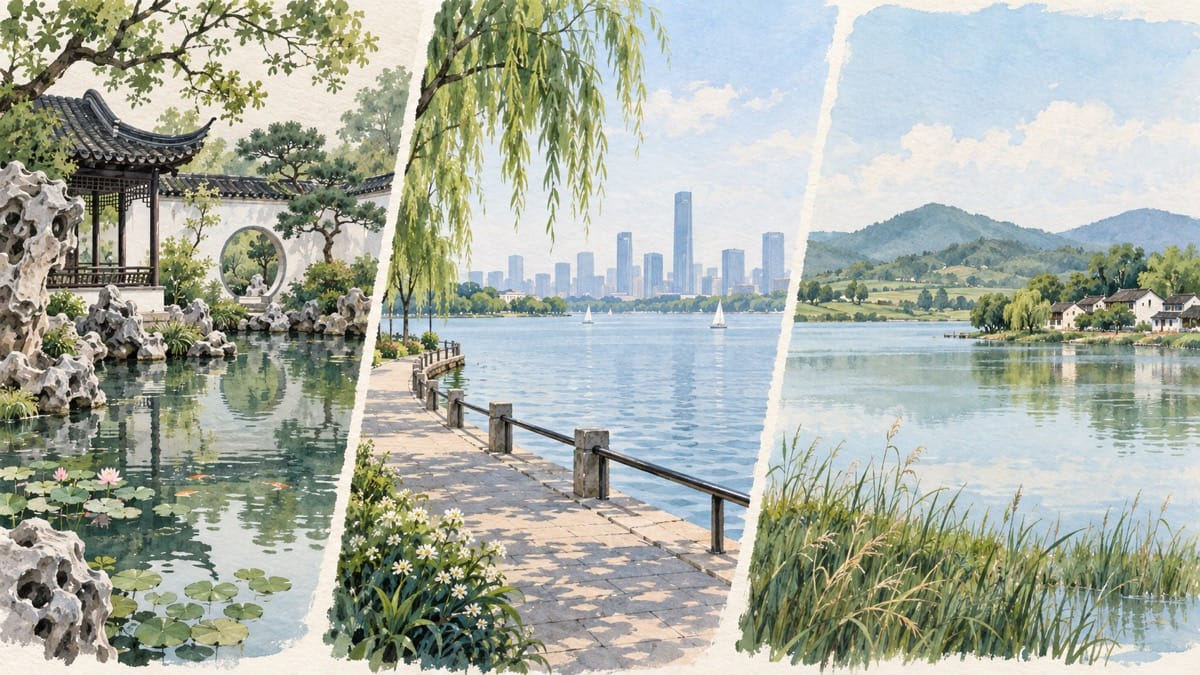

For outdoor time in Suzhou, choose a classical garden for close-up landscape design, Jinji Lake for an urban waterfront walk, or the Taihu area for a separate lakeside excursion. These are three different plans—not three neighboring stops to squeeze into the same afternoon.
This guide helps you choose the setting before arranging transport. Official sources were checked on September 16, 2026; the suggested day structures are editorial advice, not confirmed schedules. Recheck access, reservations and transport for your travel date.
Featured image: AI-generated editorial illustration of garden, urban waterfront and rural lakeside settings; not a photograph, map or single real viewpoint.
Choose the outdoor experience, not just the name
| Your priority | Start with | The planning decision |
|---|---|---|
| Architecture, rockwork and carefully framed views | One classical garden | Choose the particular garden and confirm admission before building the day around it. |
| A walk beside open water with a city backdrop | Jinji Lake | Choose one waterfront section and its exit point, rather than committing to a full circuit. |
| A change of setting beyond the central city | A named Taihu destination, such as Dongshan | Plan both directions of the transfer and give the excursion its own space in your itinerary. |
Our Suzhou destination guide introduces the wider city. Here, the useful question is narrower: do you want to study a designed landscape, stroll beside a modern city lake, or spend the day farther out?
Classical gardens: look closely rather than cover distance
UNESCO describes the Classical Gardens of Suzhou as miniature landscapes created through the arrangement of water, rocks, planting and buildings. The World Heritage property comprises nine gardens, including the Humble Administrator’s Garden, the Lingering Garden and the Master of the Nets Garden. The listing is not one venue with one entrance.
Choose a garden when you want to pause over details: how a doorway frames a view, how a path changes what you see, or how buildings relate to the pond. You do not need to collect several garden names for the visit to be worthwhile. Start with one that interests you and check its actual entrance, current booking arrangements and opening day.
A compact site does not automatically mean an easy-access route. If steps, uneven surfaces or long periods standing matter to your group, ask the particular garden about the route you intend to use. Our attraction booking guide covers the practical checks to make before paying or reserving.
Jinji Lake: choose a section of the urban waterfront
Jinji Lake (金鸡湖) is in Suzhou Industrial Park, east of the city’s historic core. The municipal government’s Around Jinji Lake guide describes a modern waterfront setting and a circuit trail of about 14 kilometres. That distance is useful scale context—not a recommendation to walk the whole lake during a short visit.
The same official guide names Ligong Dike, Moonlight Pier and Suzhou Culture and Arts Center among waterfront points. Pick one as a starting reference, then use a current map to select a nearby endpoint and check the walking route between them. Do not treat that list as a short, consecutive walk.
For a flexible visit, plan an out-and-back stroll from a clearly identified arrival point. It gives you a simple option to turn around when you have walked enough. For a one-way walk, identify the onward transport at the far end before setting off. A fountain show, boat service or indoor attraction should be an optional addition until its current operation is confirmed; an older tourism overview does not establish today’s schedule.
Taihu: name the destination before arranging the ride
Taihu Lake (太湖) is not another name for Jinji Lake. For a specific Suzhou-side option, consider Dongshan (东山). The city’s Dongshan introduction places it southwest of Suzhou, on Taihu’s southeastern shore, with water on three sides and a land connection on the fourth. It also identifies Qiyuan Garden and historic villages such as Luxiang among the area’s places of interest.
“Take me to Taihu” leaves too much unresolved. Select the exact place you want to visit, confirm its entrance or public access point, and save its Chinese name and map pin. A garden visit, village visit and lakeside stop may involve different access arrangements even within the same area.
Before committing, calculate the outward journey from your actual accommodation and the return from your final stop. If arranging a driver, agree the pickup point and return time; if using public transport, check the specific services in both directions. Do not assume an outbound route proves that an equally convenient return is available later.
Two ways to structure the day
Garden-first city day: make one confirmed garden visit the anchor, then have lunch nearby. Add a short Jinji Lake walk only if the cross-city journey and your return connection leave comfortable time. Otherwise, keep the rest of the day near the garden. The lake is an alternative setting, not an obligatory extra.
Taihu-focused day: choose one Dongshan-area visit and a separately identified lakeside stop, with lunch and both transfers planned around them. Leave Jinji Lake and central-city gardens for another day. This is a suggested planning structure, not a claim that every pair of stops is walkable or open on your date.
If you are returning to Shanghai by train, start with our Suzhou or Hangzhou day-trip comparison for station and round-trip checks. Work backward from the station on your actual return ticket, not from a generic “Suzhou” location. Set a latest departure time from the final activity and decide in advance which optional stop you will drop.
Before you leave
- Save two pins: the precise arrival point and the place where you will leave or meet your ride.
- Confirm the visit itself: check date-specific admission, reservations and any access restrictions with the relevant venue or operator.
- Check the conditions: review the local forecast and official alerts before an outdoor plan; shorten or change it when conditions require.
- Keep the plan proportionate: choose a walk your group wants to complete, with time for breaks and the return journey.
For a longer stay, see the existing Suzhou Heritage & Taihu Lakeside Escape itinerary for how city and lakeside visits can be separated across several days. To discuss your own route, send CHINA FACE your travel date, starting area and preferred outdoor setting. Include your return-train deadline if you have one; it is more useful than asking to fit every lake and garden into a single day.